Over the last decade, the “delivery revolution” standardized speed, reliability and global scalability across marketing and digital production. As those capabilities become the baseline, the advantage shifts from efficiency to intelligence: systems that learn from every release, foresee risks and connect delivery data to financial outcomes.
P2H Forge, part of P2H Group, drawing on 20 years of engineering practice and over 25,000 anonymized projects across brands, outlines the next operating model for agencies: an Agency Operating System that merges human judgment with predictive orchestration and responsible AI governance. We provide a maturity model, a governance framework (GESC), a 90-day “how to act” plan and a 2026–2030 outlook.
The decade that standardized software delivery
Between 2015 and 2025, agency delivery scaled up and optimized, turning speed and reliability into standard practice. What began as project-by-project craftsmanship shifted to industrialized execution. This included agile cadences, distributed engineering, standardized quality assurance (QA), continuous integration and continuous delivery (CI/CD) pipelines, service-level commitments and near-instant cloud deployment. Speed became the universal metric of competence, reliability and expectation rather than a differentiator.
The revolution worked. It imposed a structure where chaos once reigned. But it also flattened differentiation. If every reputable partner delivers on time and within tolerance bands, what is the next source of advantage?
The delivery revolution brought efficiency, not intelligence. We’ve standardized execution; now we have to systematize learning..png) Dmytro BreslavetsFounder, CPO, P2H Group
Dmytro BreslavetsFounder, CPO, P2H Group
This shift reframes delivery from a linear pipeline to a living system that senses, interprets and adapts. We describe the management layer enabling this as delivery intelligence—a discipline that combines human judgment with system memory and machine inference, rather than a standalone product.
Lessons from 20 years of data
When reviewing delivery outcomes across multiple markets, certain patterns consistently emerge. At P2H Forge, our analysis of these patterns reveals two key findings across geographies and disciplines:
First, most breakdowns are structural instead of technical. Missed milestones often trace to decision latency, unclear ownership or late resource synchronization rather than code itself.
Second, crises announce themselves early. The key signal is what we call delayed-decision density, when small approvals that should move routinely (copy tweaks, asset validation, minor scope clarifications) start clustering instead of flowing. By the time a deadline is visibly at risk, decision density has usually been elevated for weeks.
Longitudinal analysis reveals a predictable evolution path (see Exhibit 1: The four stages of delivery maturity):
- Reactive: fragmented tools; manual tracking; heroics and firefighting.
- Systemized: defined ceremonies and QA checklists; reliable but static.
- Intelligent: real-time dashboards; analytics-informed planning; cross-team learning.
Predictive: self-optimizing workflows; AI-assisted foresight; decision automation with human override.
Exhibit 1: The four stages of delivery maturity
Moving from Stage 2 to 3 yields the highest median ROI (≈31% margin gain) as organizations shift from visibility to interpretation. Stage 4 creates durable differentiation through foresight and governance: fewer schedule shocks, tighter confidence intervals in financial forecasts and a measurable reduction in compliance review time.
With enough delivery memory, you can forecast the health of a program before the crisis, not after. Dmitrii KucherFounder, CEO, P2H Group
With these lessons in hand, the next practical step is rethinking everyday agency workflows to match how fast marketing keeps moving.
Where the marketing industry is heading
Marketing organizations are entering a post-efficiency era. Intelligent automation is saturated; agile is table stakes; globally distributed teams are normalized. The next constraint is orchestration: coordinating creative, engineering, data and compliance as a coherent system.
We see five converging trends reshaping how agencies operate:
- AI delivery orchestration platforms: real-time coordination of work, resources and dependencies across creative, engineering and analytics teams.
- Compliance-as-a-system (CaaS): embedded validation for privacy, accessibility, brand integrity and legal constraints that runs during delivery, not after.
- Composable agency infrastructure: modular stacks where interoperable APIs replace rigid project silos, making it easier to swap tools, govern and scale
- Augmented QA pipelines: models that predict design regressions and accessibility issues pre-deployment, moving QA from routine checks to risk-based review.
- Data-bound brand-integrity frameworks: automated governance that enforces brand consistency across thousands of assets and channels.
Early adopters in North America and Europe already operate with hybrid human-AI orchestration, embedded governance and modularized delivery cells interfacing with CRM and analytics stacks. The boundary between “marketing” and “software engineering” is dissolving; delivery is becoming a productized operation.
The agency of the future won’t run on briefs and deadlines; it will run on signals and predictions.Dmytro BreslavetsFounder, CPO, P2H Group
To meet this future head-on, agencies have to adopt a fundamentally different operating model that smoothly integrates technology, people and data.
The new agency operating model
By 2026, competitive agencies will look less like traditional studios and more like hybrid software enterprises with creative cores. Their edge will come from how intelligently they connect human judgment, system memory and machine inference.
We call the enabling layer the Agency Operating System (Agency OS) – a dynamic, cross-functional spine that synchronizes them (see Exhibit 2: The Agency Operating System). It runs across three tightly coupled horizons:
- Real-time orchestration. Predict workload collisions, auto-sequence dependencies and flag anomalies before they escalate.
Outcome: fewer schedule shocks; higher schedule credibility with clients. - Adaptive governance. Convert live delivery data into compliance and financial signals (privacy, accessibility, brand integrity, budget drift).
Outcome: reduced rework and audit time; lower risk capital. - Strategic foresight. Link delivery metrics to margin and client-retention probabilities; simulate portfolio scenarios.
Exhibit 2: The Agency Operating System
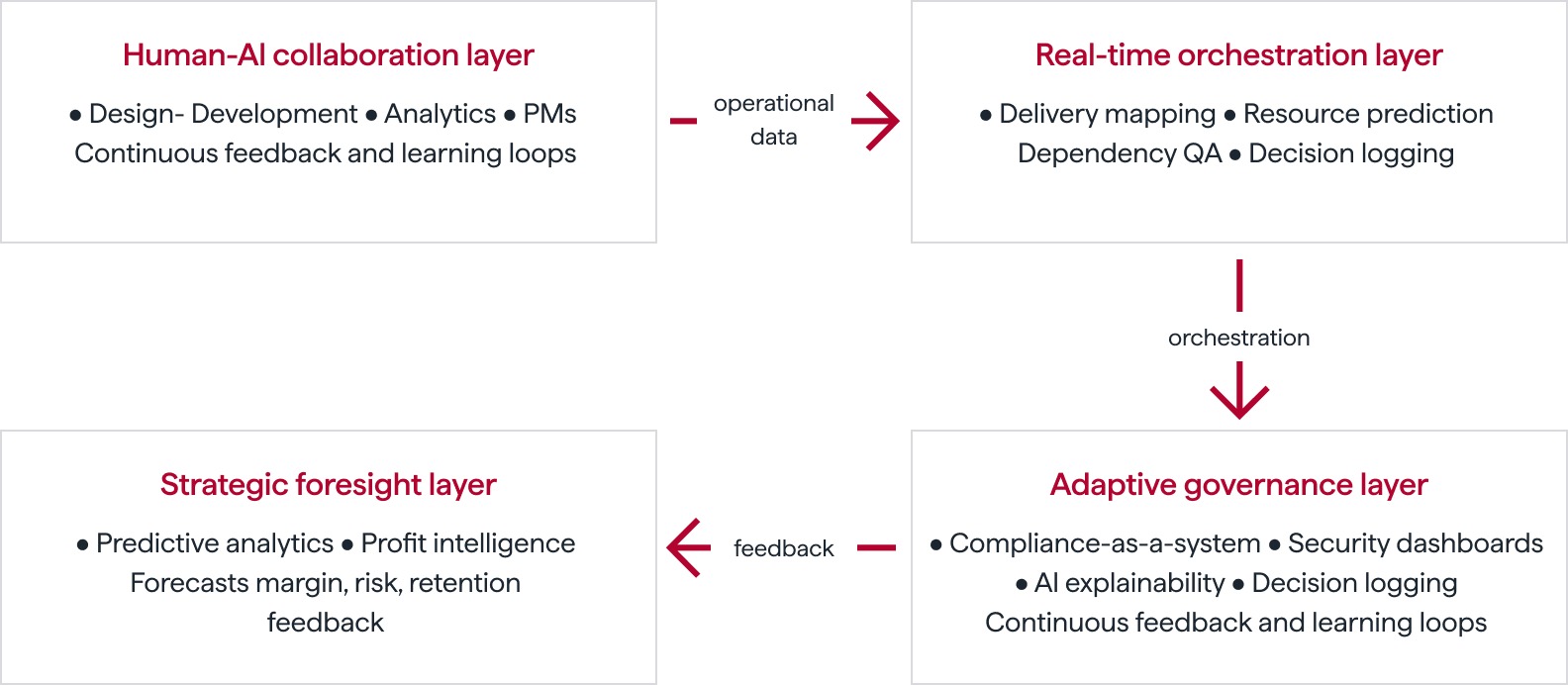
As a result, agencies achieved portfolio-level predictability and optimized capital allocation.
By 2026, the best agencies won’t buy hours; they’ll buy intelligence – the capacity that improves itself.Dmytro BreslavetsFounder, CPO, P2H Group
Financially, this model compounds. Traditional optimizations cap at single-digit gains. When every sprint trains the next one across teams, clients and platforms, improvements accumulate as compound operational capital.
Moving to this new model is a journey. Here’s a pragmatic roadmap for beginning that evolution.
How to act: starting the shift toward delivery intelligence
Transitioning from structured delivery to intelligent operations does not require a full rebuild. It starts with learning to measure what your systems already reveal. The first 90 days should focus less on tools and more on visibility:
- Instrument your operations. Add two metrics to weekly dashboards: mean time to insight (MTTI) and delayed-decision density. They expose friction long before delays surface.
- Run a focused pilot. Select one client pipeline. Embed adaptive feedback loops: predictive QA triage, live dependency mapping and decision logging with accountable owners. Measure predictability on top of speed.
- Reframe roles. Shift PMs and delivery leads from task controllers to signal interpreters, converting operational data into business foresight.
- Institutionalize learning. Archive every anomaly and decision into a searchable repository. By the next quarter, that repository becomes your first layer of delivery intelligence.
Intelligence isn’t built; it’s trained on every project, every anomaly, every decision you capture.Dmytro BreslavetsFounder, CPO, P2H Group
The responsible software delivery era
As orchestration becomes predictive with responsible AI engineering that supports decision-making, trust transforms into the central currency. Here, the question shifts from who automates the most to who governs best.
We encapsulate the governance discipline in the GESC framework: Governance, Explainability, Security, Continuity (see Exhibit 3: The GESC framework):
- Governance: role-based accountability for automated actions; auditable decision logs with owners.
- Explainability: transparent algorithms and human-readable rationales for resource allocation, prioritization and risk scoring.
- Security: encryption, access tiers and data localization; privacy-by-design across delivery pipelines.
- Continuity: graceful degradation and failover plans; systems fail safe instead of fail closed.
Exhibit 3: The GESC framework for responsible delivery
Regulatory momentum will speed up this transition. As standards tighten, agencies that operationalize compliance as a living system rather than a post-hoc checklist become preferred partners for global brands. Internally, roles evolve: project managers become governance architects, and COOs take on the role of system stewards, responsible for transparency and resilience.
AI without accountability is a liability. Responsible delivery turns automation into an advantage.Dmitrii KucherFounder, CEO, P2H Group
Outlook 2026–2030: three trajectories to watch
- Delivery becomes predictive infrastructure
Self-learning orchestration platforms recommend timelines, buffers and team compositions before work begins. Expect up to 40% fewer overruns and tighter SLA confidence intervals. - Operations converge with growth strategy
The COO evolves into a profit architect. Operational metrics (velocity, rework, QA yield, decision latency) feed retention and LTV models. Boards evaluate delivery health alongside pipeline health. - Partnerships platformize
Bilateral outsourcing gives way to co-owned delivery intelligence with shared repositories, shared risk and shared learning across ecosystems. The strategic contract grows from headcount and rate cards to data access and governance standards.
From our vantage point, at P2H Forge, these arcs are the essentials. Creative industries are industrializing their decision logic. Advantage accrues to leaders who treat delivery not as cost, but as compound intellectual capital—captured, governed and reused.
Closing reflections: the invisible system
When you stop seeing delivery as a department and start seeing it as a living system – that’s when creativity scales sustainably.Dmitrii KucherFounder, CEO, P2H Group
The next decade belongs to agencies that think operationally but deliver emotionally, blending precision with empathy and automation with accountability.Dmytro BreslavetsFounder, CPO, P2H Group
Human–AI synthesis: the next frontier of creative operations
The convergence of human judgment and machine intelligence will define the next decade of agency growth. Algorithms can optimize sequences, but only people can decide what matters. The future operating model will not automate creativity; it will contextualize it.
AI will act as the second brain of operations, absorbing complexity so teams can focus on meaning. It will surface unseen dependencies, quantify risk and enable leadership to make decisions that are much faster and, more importantly, wiser. As the outcome, we will see a new balance of human intuition, grounded in data and amplified by intelligence. Agencies that master this synthesis will deliver work with designed systems that think, adapt and evolve with every project they touch.
*Disclaimer
P2H Forge is an end-to-end technology partner within P2H Group, built on the foundation of over 20,500 successfully launched projects. P2H Forge supports agency-led execution across sectors where stability, compliance and long-term scale are critical, working in embedded, often white-label formats.
.png)

%20(1).png)
.png)

.png)



.png)
.png)

.png)
.png)